
Stainless steel, any one of a family of alloy steels usually containing 10 to 30 percent chromium. In conjunction with low carbon content, chromium imparts remarkable resistance to corrosion and heat. Other elements, such as nickel, molybdenum, titanium, aluminum, niobium, copper, nitrogen, sulfur, phosphorus, or selenium, may be added to increase corrosion resistance to specific environments, enhance oxidation resistance, and impart special characteristics.
General Properties of Stainless Steel
Aesthetics
Stainless steel has a great variety of surface finishes, from matt to bright and including brushed and engraved. It can be embossed or tinted, making stainless a unique and aesthetic material. It is often used by architects for building envelopes, interior design and street furniture
Mechanical Properties
Compared to other materials, stainless steel has strong mechanical properties at ambient temperatures – it is steel after all! In particular, it combines ductility, elasticity and hardness, enabling it to be used in difficult metal forming modes (deep stamping, flat bending, extrusion, etc.) while offering resistance to heavy wear (friction, abrasion, impact, elasticity, etc.). Furthermore, it offers good mechanical behaviour at both low and high temperatures.
Corrosion Resistance
With a minimum chromium content of 10.5%, stainless steel is continuously protected by a passive layer of chromium oxide that forms naturally on the surface through the reaction of the chromium with oxygen from air or water. If the surface is scratched, it regenerates itself. This particularity give stainless steels their corrosion resistance.
Cleanability
Stainless steel items are easy to clean, usual cleaning products (detergents, soap powders) are sufficient and do not damage the surface. Stainless steel fully meets the requirements of decoration and cooking utensils that require frequent and effective washing.
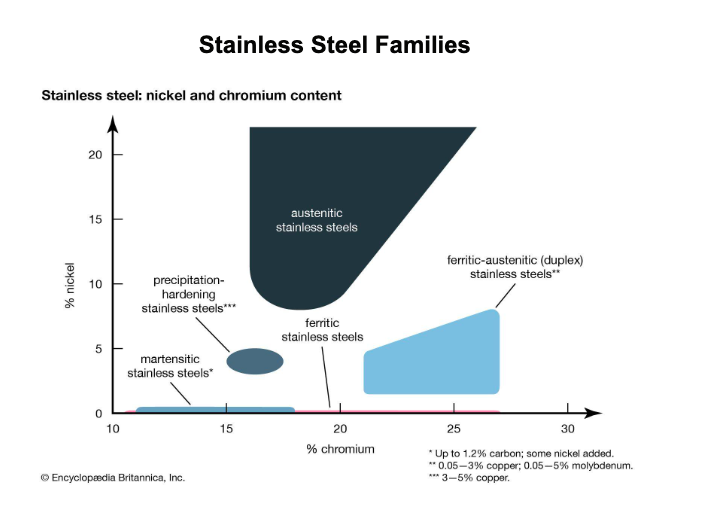
Stainless Steel Families

Austenitics or 300 series
0.015 to 0.10% carbon, 16 to 21% chromium, 6 to 26% nickel, 0 to 7% molybdenum. The presence of nickel improves corrosion resistance in certain media and makes stainless steel more ductile. The presence of molybdenum further enhances the resistance to corrosion in an acid medium. The most common grades are 304/304L and 316/316L.
Applications
Boiler market, aeronautics, electronic components, railway equipment, tubes, chemical tanks and food vats, marine applications, containers, etc.
Heat resistant steel applications
Heating systems, resistor jackets, furnace equipment.
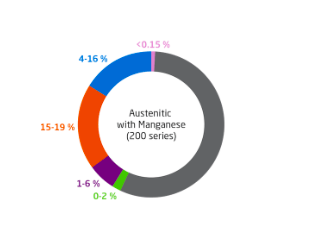
Austenitics with manganese or 200 series
These are chromium manganese steels, with a low nickel content (always below 5%).
Applications
Asphalt tankers, tubes, food containers, silos, conveyor chains, safety soles, etc.
Ferritics or 400 series:
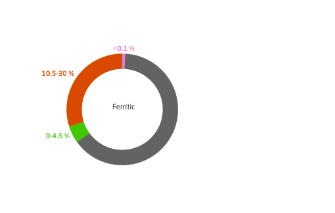
0.02 to 0.06% carbon, 10.5 to 30% chromium, 0 to 4% molybdenum. Commonly used internally, these grades are now being developed for envelope and structural products.
Applications

Car exhaust systems, conveyor chains, cooking utensils, boilers, domestic appliances, trim, dishware, heating, hot water tanks, tubes, etc.
Austeno-ferritics or Duplex
0.02% carbon, 0 to 4% molybdenum, 1 to 7% nickel and 21 to 26% chromium. These stainless steels not only offer excellent quality, because of their low nickel content – a material that suffers from highly speculative prices – they are also very cost effective.
Applications
Oil, gas, pulp and paper, desalination sectors, chemical industry, etc.
Martensitics
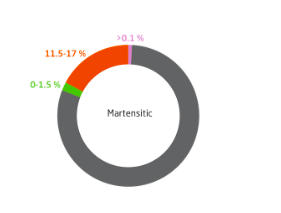
0.1% carbon, 10.5 to 17% chromium.
Applications
Cutlery, cutting tools, hand tools, springs, etc.